Let us begin with the promise other pages will not make: the eastern Mediterranean is not a tropical aquarium, and we will not pretend it is. There are no clownfish here and no coral gardens in postcard colours. What there is instead is a warm, astonishingly clear sea with a cast of characters all its own — silver clouds of bream, octopus that melt into rock, moray eels peering from crevices, and the occasional turtle that turns a good dive into a story you tell for years.
This guide covers what you can realistically expect to see on our dives between Side and Alanya — no more, no less. Everything below is the ordinary truth of this coast, which, seen from a metre away through a well-fitted mask, turns out to be extraordinary enough.
An Honest Portrait of the Eastern Mediterranean
The sea off Antalya is one of the warmest and saltiest corners of the Mediterranean, and — a genuine gift to divers — one of the clearest. With little plankton to cloud the water, visibility here is often excellent, which is why even a first dive at 5–8 metres feels spacious and blue rather than murky and closed-in. Sunlight reaches deep, colours stay true, and a diver hanging above a reef can usually see far more of the landscape than in many more famous seas.
The underwater terrain is the second surprise. Where the sandy tourist beaches end, the coast breaks into rocky reefs, boulder slopes, small caves and shoals — hard structure that Mediterranean life depends on. Almost everything you will meet on a dive lives in, on or around rock: fish patrolling the reef edges, octopus denning in holes, morays threaded into cracks. This is why our five boat trips head for reef, cave and rock formations rather than open sand, from the reefs of Kemer to the caves and rocky reefs in the Cleopatra Beach waters off Alanya.
One more honest note about rhythm: the Mediterranean rewards the patient. Its creatures are masters of camouflage and habit, not spectacle. A diver who rushes sees stone; a diver who slows down, guided by an instructor who knows each reef personally, sees the stone start to move. With only 3–4 divers per instructor on every trip, our guides have the time to point — and that pointing finger is worth more than any aquarium glass.
The Regulars: Bream, Damselfish and Wrasse
Three families of fish will keep you company on virtually every dive on this coast, and learning to tell them apart is half the fun of a first dive log.
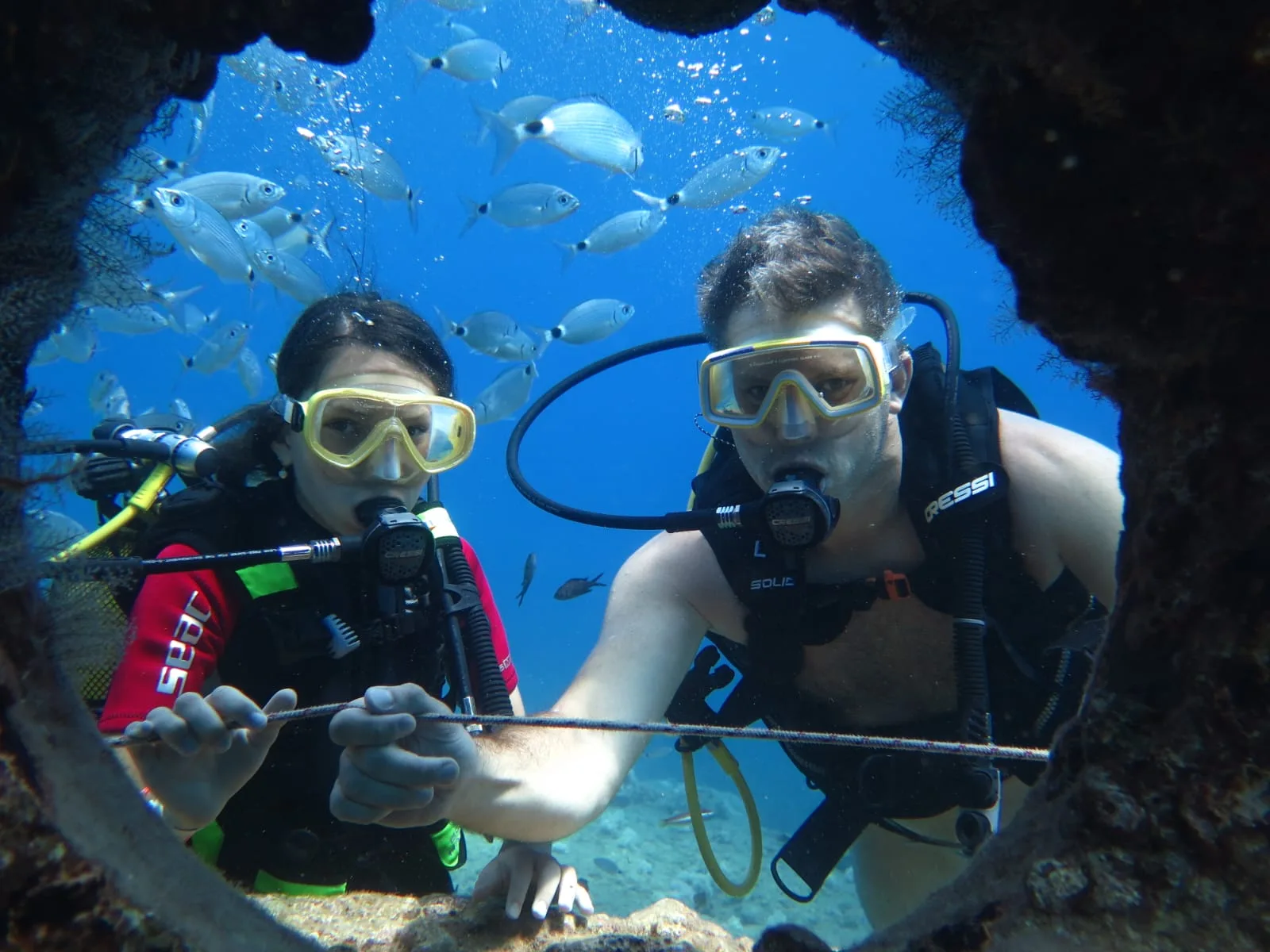
Sea bream are the silver heart of the Mediterranean reef. They move in loose, flickering schools along the rock edges, catching the sunlight like handfuls of thrown coins. Several bream species share these reefs, from small shoaling fish to larger, warier individuals that hang just at the edge of visibility, and a school parting around a diver is often the first moment newcomers realise they are truly inside the sea, not looking at it.
Damselfish are the small dark fish you will see everywhere above the rocks, hovering in mid-water like a scattering of commas. Unimpressive at first glance, they are fiercely territorial little characters — watch one for thirty seconds and you will see it chase off fish twice its size. Their dense shoals over every reef head are the constant background of Mediterranean diving.
Wrasse supply the colour this sea is unfairly said to lack. These busy, cigar-shaped fish patrol the rocks in greens, oranges and blues, males often more vivid than females. They are curious by nature and frequently come to inspect a calm diver at close range.
On our flagship Side Underwater Museum dive, this cast presses in closer than anywhere else: among the sunken sculptures you can hand-feed the exotic fish that gather around the exhibits, and the cloud of life that forms around your fingers is, for many guests, the single image they take home from Turkey.
The Characters: Octopus, Morays, Groupers — and Rare Guests
Beyond the everyday fish, this coast keeps a cast of personalities that turn a pleasant dive into a memorable one.
The octopus is the one guests most hope to meet, and with a sharp-eyed guide the odds are good. Octopus den in holes and crevices, often betrayed by a tidy midden of empty shells at the doorstep. Spotted in the open, one may pour itself across the rock, switching colour and texture as it goes — one of the most sophisticated camouflage systems in nature, performed live at arm's length. We look, we marvel, and we never touch.
Moray eels look fearsome and are not. That open-mouthed "snarl" from a crevice is simply how a moray breathes, pumping water over its gills. Left in peace — and we always leave them in peace — a moray is a placid resident that poses obligingly for photographs, all patterned skin and ancient expression.
Groupers are the reef's heavyweights: broad-shouldered, big-lipped fish that hold territories around rocks and caves and inspect divers with an air of unhurried ownership. Larger individuals tend to keep to the deeper, quieter corners, which is one more reason the deeper afternoon dive often delivers the day's best encounter — and why certified divers, who go deeper still, so often come up with the story of the day.
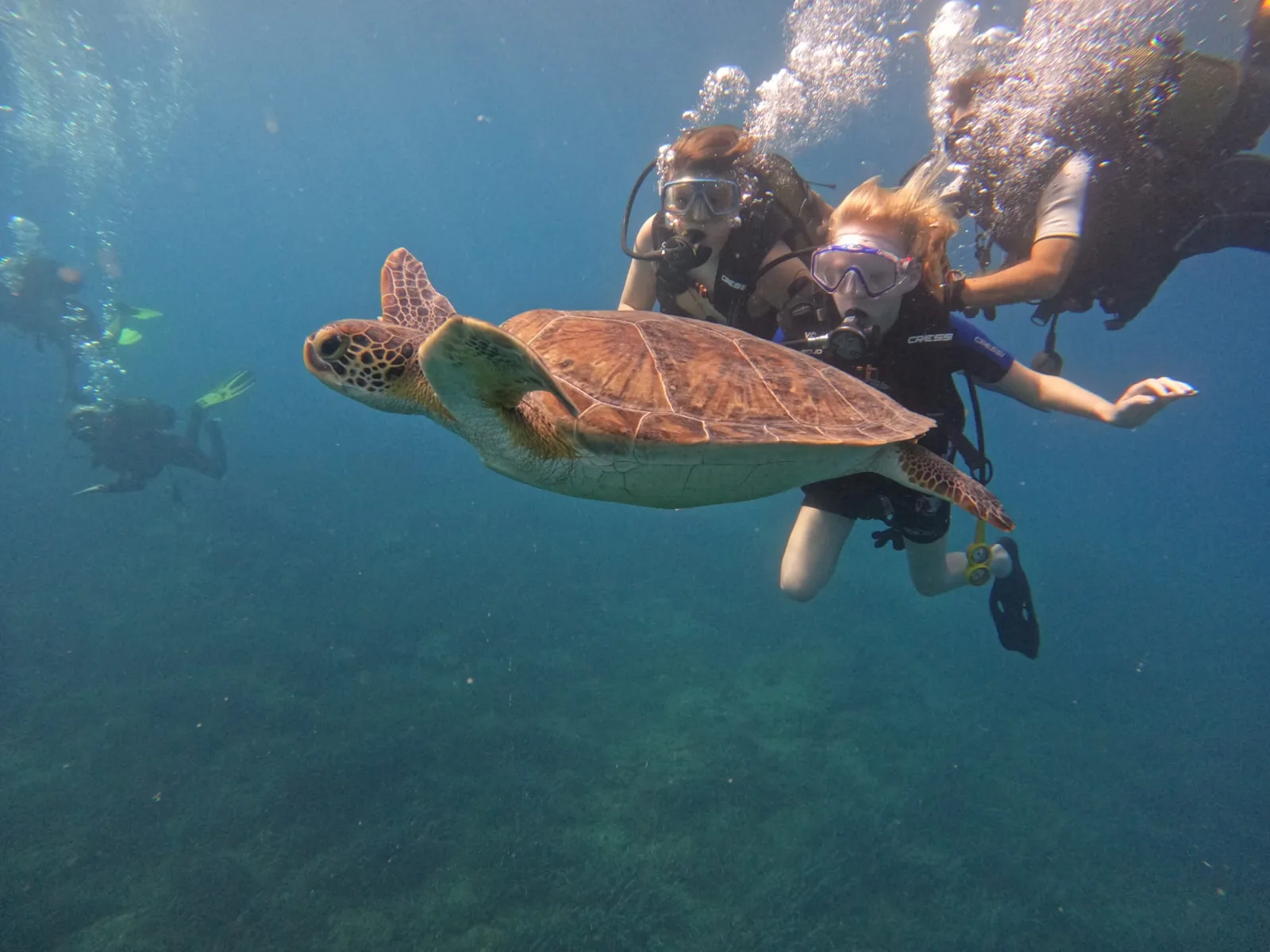
And the rare guests? Sea turtles and rays do cross our dive sites — this coast is part of their world — but they are occasional visitors, not residents, and we will never promise one. When a turtle does sail past a dive group, it is precisely its unscheduled arrival that makes the moment priceless. That is the honest deal of Mediterranean diving: the regulars are almost always around, the celebrities drop in unannounced.
How to Be a Good Guest Underwater
Everything on the previous lists survives because divers on this coast, generation after generation, have mostly behaved well. We ask every guest — beginner or veteran — to keep four simple habits, and our instructors model all of them on every dive.
Touch nothing living. Fish, octopus, urchins, shells with something home inside: all are look-only. A touched octopus loses precious energy; a grabbed rock edge may be an animal's roof. The single exception on our trips is the guided hand-feeding of fish at the Side Underwater Museum, done under your instructor's direction as part of the experience — the fish come to you, never the reverse.
Collect nothing. Shells, stones, "just one souvenir" — the reef's furniture stays on the reef. Empty shells become homes for hermit crabs and octopus; a bare-looking stone is usually someone's ceiling. Photographs travel better anyway, and our optional underwater photo and video service exists for exactly this reason.
Master your position. The most common accidental damage underwater comes not from malice but from knees and fins. Staying comfortably off the bottom is a skill your instructor will help you build from the very first dive at 5–8 metres — and with only 3–4 divers per instructor, nobody drifts unnoticed into the scenery.
Leave only bubbles. Nothing goes into the sea from our boats, and anything found drifting — a stray bag, a lost line — usually comes back up with us.
Dive this way and the reef repays you: animals that are not harassed stop hiding. If you are ready to meet the residents in person, start with our beginner diving guide or browse all five boat trips.