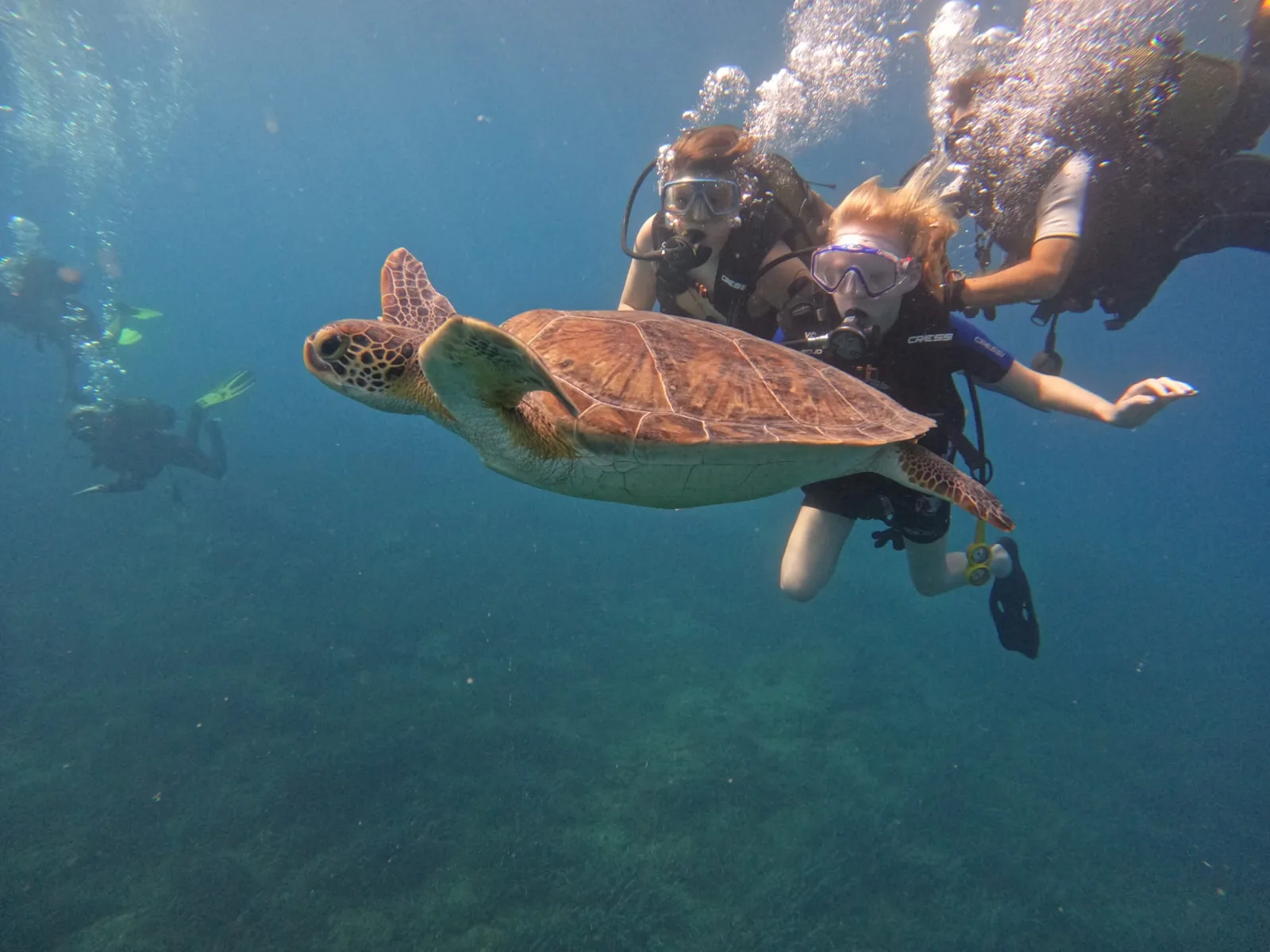
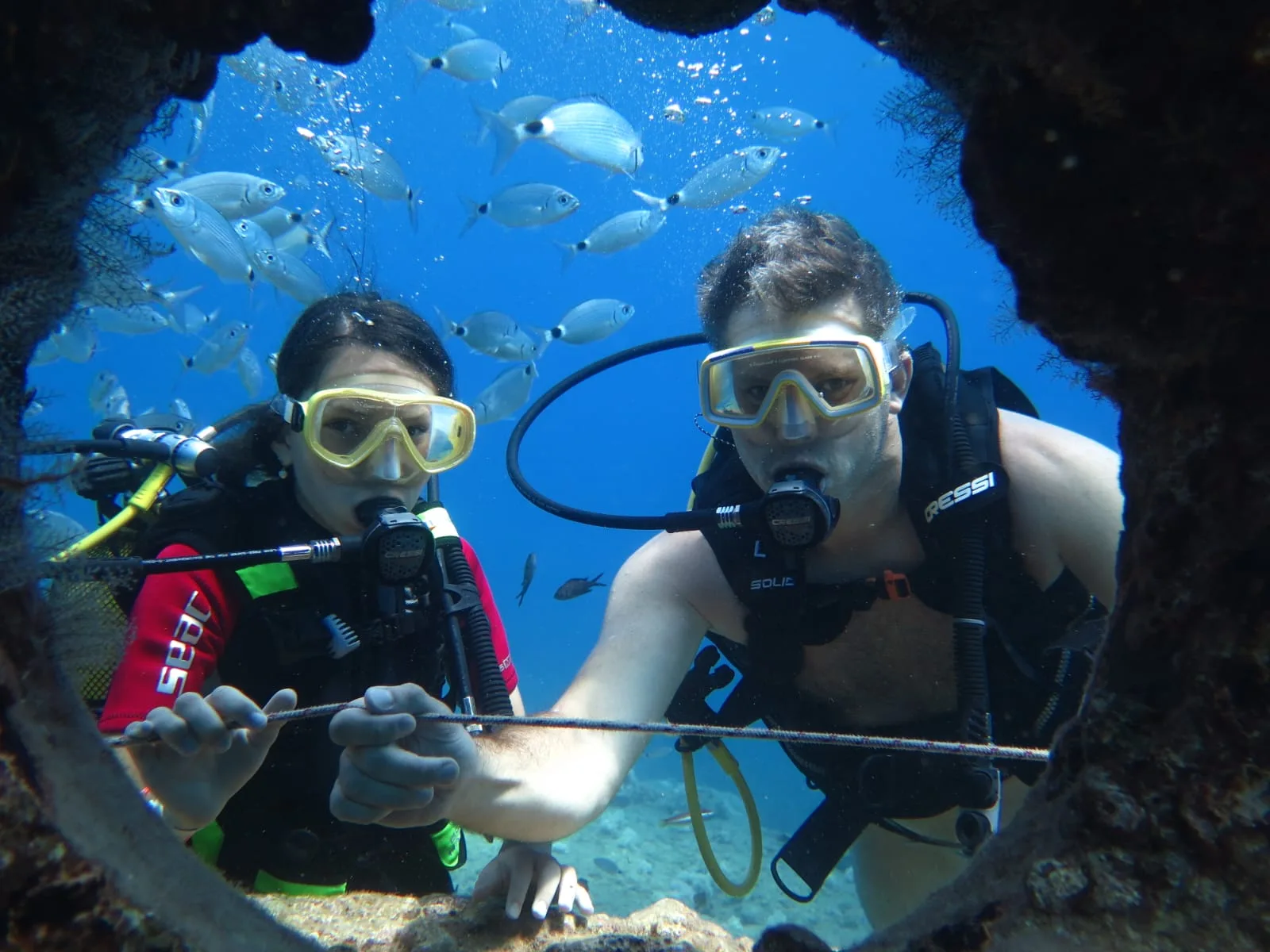
Every guest who steps onto our boat is trusting us with something bigger than a holiday activity, and we never forget it. Safety at Side Diving is not a laminated poster by the ladder — it is the way the whole day is built: small groups, gentle depths, checked equipment, clear rules, and an instructor who stays beside you from the briefing to the ladder.
This page explains exactly how that works, including the limits we set, the health conditions that rule diving out, and the one rule that continues after you leave the boat. We would rather you read it before booking than wonder about it underwater.
A First Dive Designed to Be Gentle
Most of our guests have never dived before, so the entire day is engineered around a calm first experience — and it starts before anyone gets wet. Every trip begins with a thorough safety briefing covering the three things a new diver actually needs: how to breathe from a regulator (slowly, deeply, and never holding your breath), the underwater hand signs you will use to talk to your instructor, and a full equipment fitting so your mask seals, your wetsuit fits and your gear feels like it belongs to you before you enter the water.
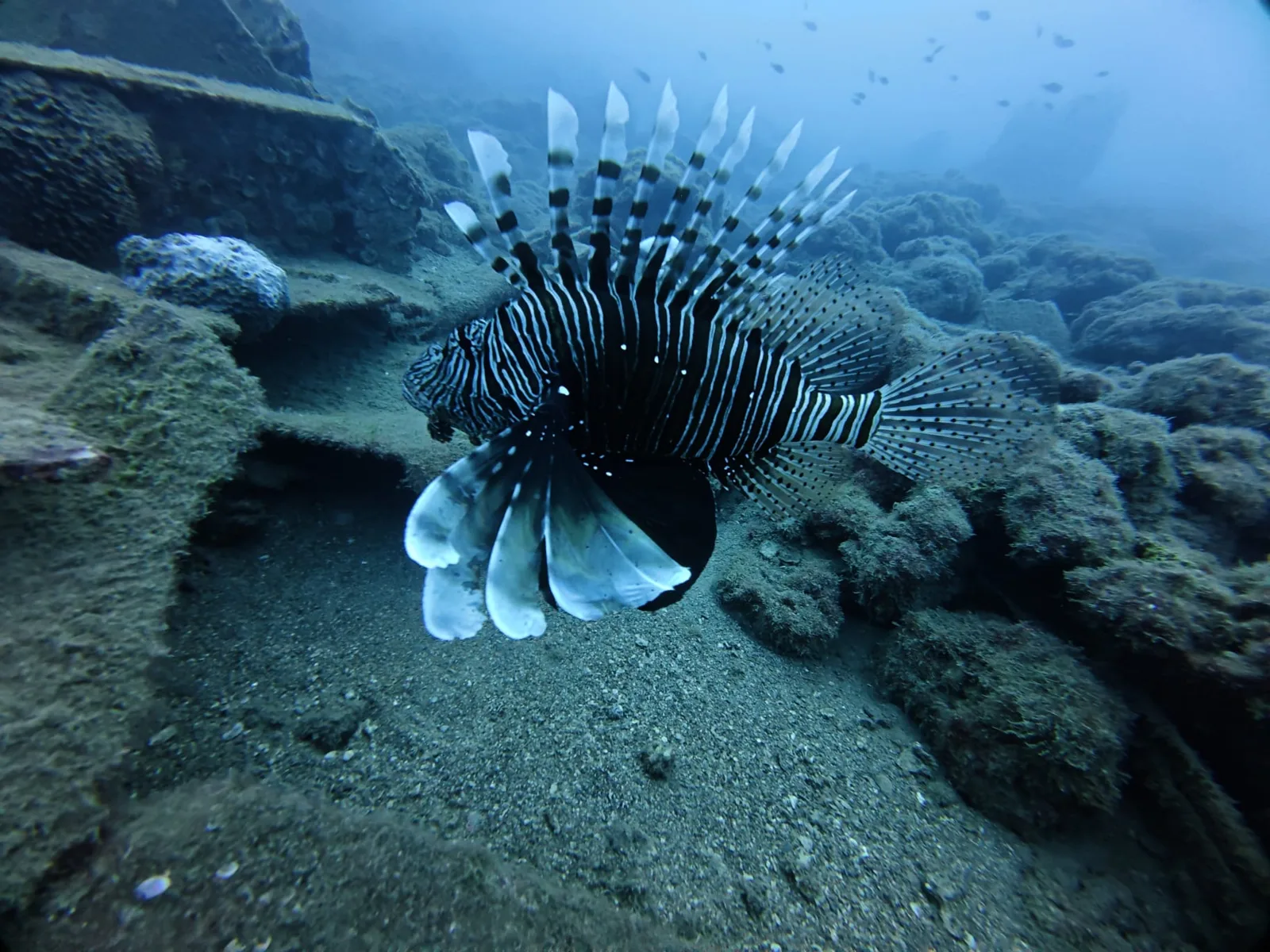
Then the diving itself is staged like a staircase, not a leap. Your first dive is a gentle morning dive at 5–8 metres for 15–25 minutes — shallow enough that sunlight fills the water and the surface stays reassuringly close, long enough to find your breathing rhythm and start noticing fish instead of thoughts. Only in the afternoon, once you have proven to yourself that you can do this, comes the deeper second dive to about 13 metres. That is our ceiling for beginners — deep enough for reefs, caves and the best marine life, and comfortably within the range where new divers do well. Certified divers on the same boats dive the real profiles their qualification allows — around 30 metres on standard certified dives and down to 60 metres on the deep sites for suitably qualified divers — but that is never where a first-time diver goes.
No licence is required for any of this, and no swimming records either. What we ask for is honesty about your health (more below) and a willingness to listen during the briefing. If, after the briefing, you decide diving is not for you today, you simply enjoy the boat, the snorkelling and the lunch as a visitor — nobody is ever pressured into the water. Curious how a first dive feels step by step? Read our guide to discover scuba diving.
An Instructor Within Arm's Reach — and Equipment We Check Ourselves
The single most important safety device on any dive is not made of rubber or steel: it is a professional who is watching you, and only you and a few others. On every Side Diving trip the ratio is 3–4 divers per instructor, maximum. Underwater, your instructor stays within arm's reach — close enough to adjust your mask, steady your buoyancy, answer a hand sign instantly, or simply hold your hand for the first few metres if that is what settles your nerves. This is not a special arrangement; it is how every one of our dives runs, with professional instructors across all five bases — including PADI-certified instructors on our Kemer trips.
The equipment earns the same attention. Everything you dive with — tank, regulator, wetsuit, mask, fins — is our own professional gear, included in every trip price and serviced and checked by us rather than rented from strangers. Before each dive your instructor checks your setup piece by piece: tank valve open, regulator breathing cleanly, gauges reading correctly, straps and releases secure. You will see these checks happen; we do them visibly and in order, because a routine you can watch is a routine you can trust. A thermal inner suit (diving undergarment) or any extra neoprene layer is not included in the price and is available as an optional extra on request.
Two more quiet safeguards shape the day. First, dives are guided from start to finish — you never navigate alone, and your instructor manages depth, time and direction so you can concentrate on breathing and looking. Second, the boat itself stays above the dive site with crew aboard, so the surface is never an empty horizon. Certified divers get the same standards with more latitude within our limits — and a properly signed and stamped logbook at the end of the day.
Health Rules We Never Bend
Recreational diving at our depths is gentle, but it is still real diving, and some medical conditions make it unsuitable. We would rather lose a booking than take a risk with a guest, so these rules are fixed:
Diving is not suitable during pregnancy. There is no safe way to take an unborn child on a dive, and no exception to this rule anywhere in responsible diving.
Diving is not suitable with severe asthma, heart conditions or respiratory conditions. Breathing compressed air at depth places demands on the heart and lungs that these conditions can turn dangerous. If you have a milder or well-controlled condition and are unsure where you stand, do two things: talk to your doctor before your holiday, and tell us honestly before booking — we will give you a straight answer rather than a hopeful one.
Do not fly within 24 hours of your last dive. After diving, your body carries dissolved nitrogen that needs time to leave gradually; cabin pressure at altitude can turn that leftover nitrogen into a serious problem. The rule is simple and non-negotiable: finish diving at least a full day before your flight home. When you book, glance at your departure date — and if the timing is tight, we will help you choose an earlier day.
None of this should frighten a healthy guest: for the great majority of people, including complete beginners, children's grandparents and nervous swimmers, our staged two-dive format is well within comfortable limits. The rules exist for the minority for whom diving is genuinely wrong — and honesty on the booking form is what keeps everyone in the first group.
Insured, Licensed, and Honest About It
Every guest on every trip is covered by full passenger and diving insurance, included in the price — not an optional extra, not an upsell at the desk. From the moment our free transfer collects you at your hotel in the morning to the moment it returns you, you are covered as both a boat passenger and a diver. We operate as a licensed diving business, our instructors are certified professionals, and our boats carry the safety equipment a commercial passenger vessel is required to carry.
We are equally straightforward about the small print that other operators leave for the beach flag: cancellation is free up to 24 hours before departure, and because you reserve online without paying and pay on the day (cash or card), an honest change of heart never costs you money. If the weather or sea conditions are not right for safe diving, we make that call conservatively — a postponed dive is a much better story than a rough one.
What can you do from your side? Three things. Sleep reasonably well the night before and go easy on alcohol — a clear head is diving equipment too. Tell your instructor anything relevant on the day: a blocked ear, a touch of seasickness, nerves that got worse on the way — every one of these is manageable when we know about it, and none is embarrassing. And follow the 24-hour no-fly rule when planning your last dive day.
That is the whole system: gentle depths, close instructors, checked gear, honest health rules, real insurance. If any question remains — about a medical condition, about diving with children, about anything on this page — ask us before you book. Or see how the format feels in practice on our beginner diving guide.