Social media has made freediving look magical: a single breath, a long fin, a silent glide down a blue rope. Meanwhile scuba diving — the tank, the bubbles, the unhurried hovering — can seem almost old-fashioned next to it. Guests on our boats in Side ask us regularly which one they should try. The honest answer depends on who you are, how much time you have, and what you want to feel underwater. Here is the full comparison, without romance in either direction.
The Fundamental Difference: One Breath vs a Tank of Air
Freediving (also called apnea diving) means descending and returning on a single breath. No tank, no regulator — just your lungs, a mask and usually long fins. A dive lasts as long as your breath-hold allows, typically well under two minutes for beginners, and most of that time is spent moving down and back up.
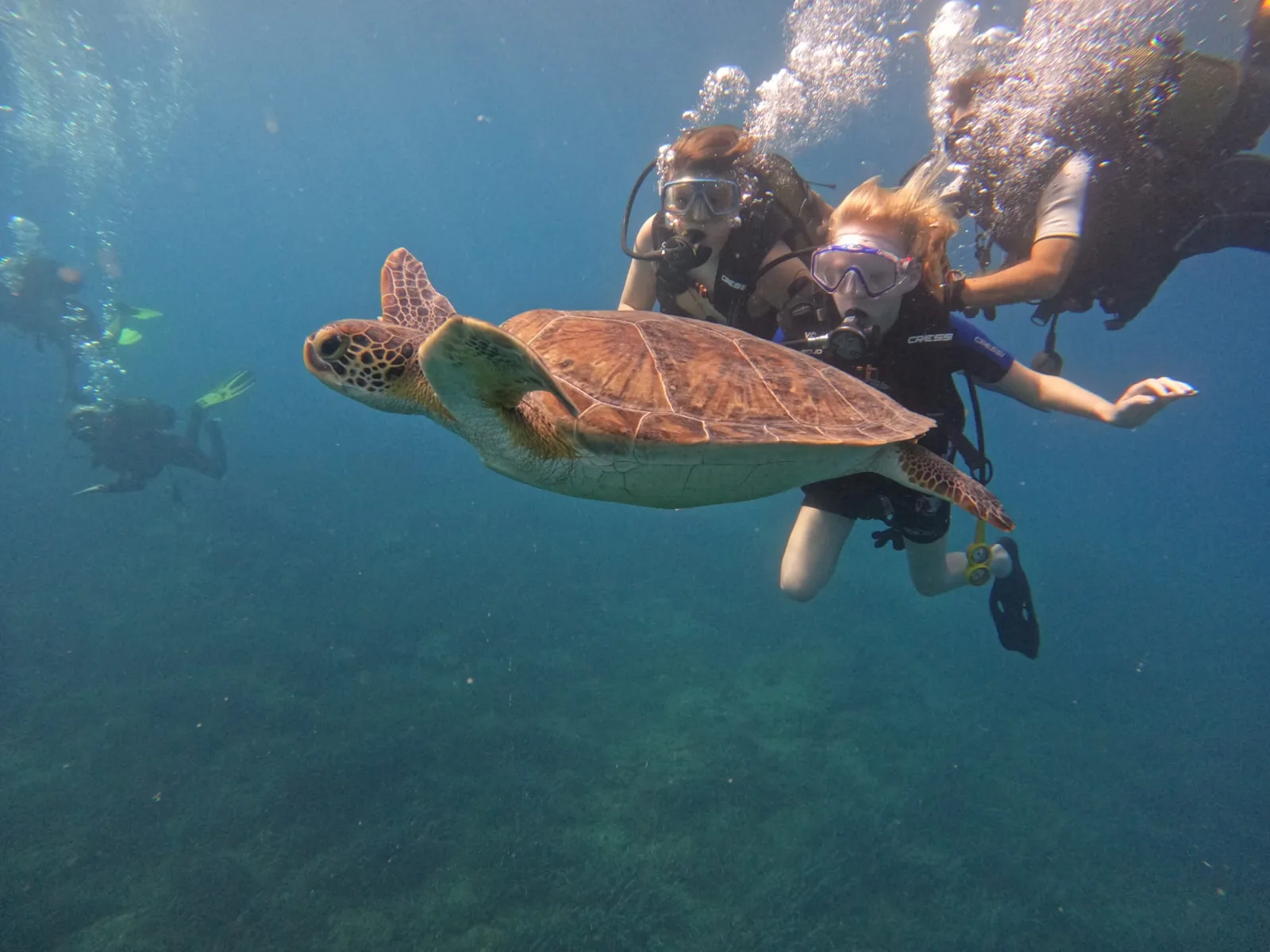
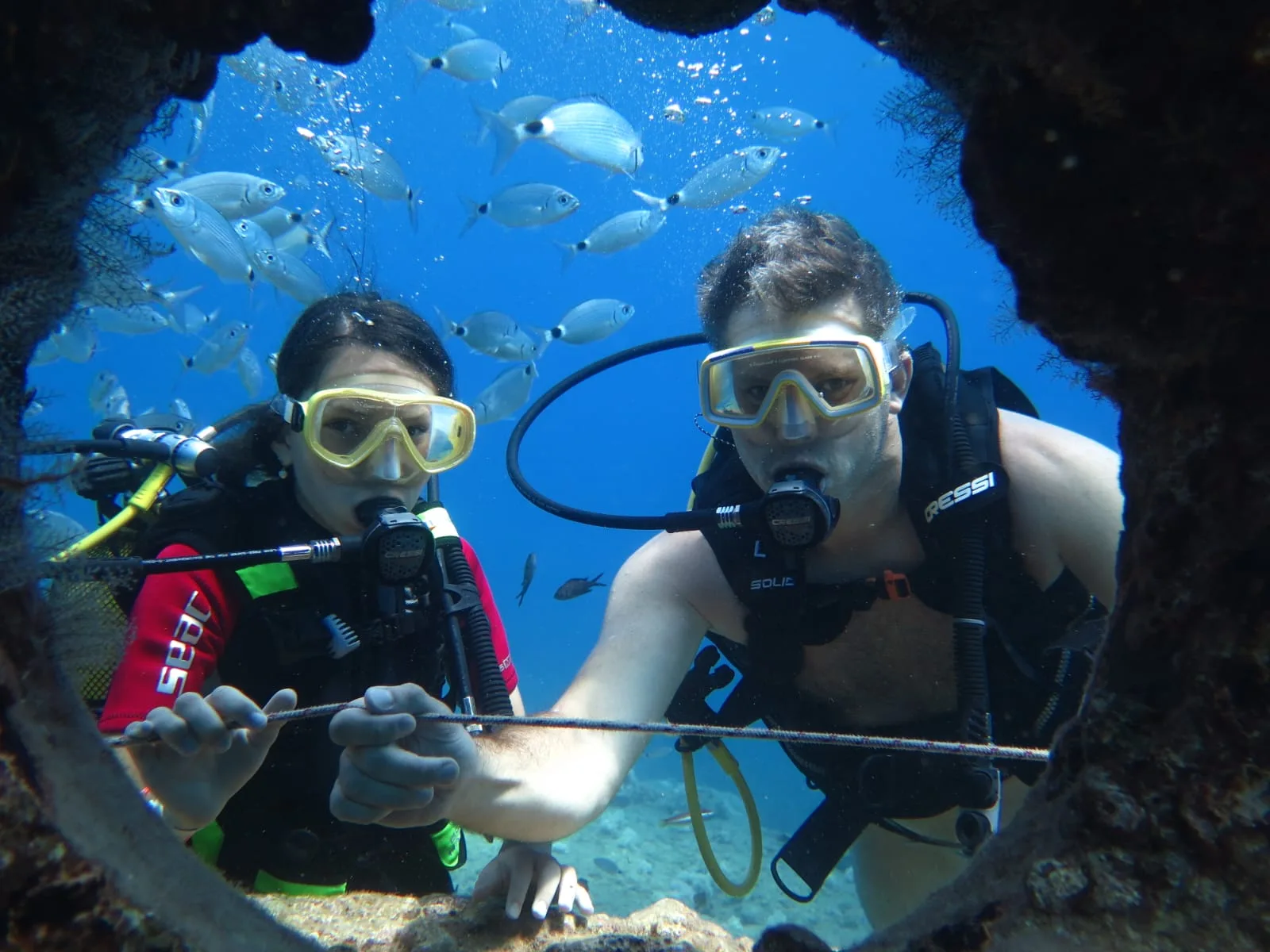
Scuba diving gives you a cylinder of compressed air and a regulator that delivers it at exactly the pressure you need. You breathe continuously and normally, which means time stops being the enemy. On our boat trips a first guided dive lasts fifteen to twenty-five minutes at five to eight metres — an eternity compared with any breath-hold, and long enough to stop rushing and start looking.
Training and the Learning Curve
This is where the two sports genuinely diverge:
- Freediving rewards long practice. Meaningful breath-hold ability is built over weeks and months of relaxation technique, CO2 tolerance and equalisation training. A one-day taster gives you the flavour, not the skill.
- Scuba delivers on day one. Because the equipment does the breathing work, a complete beginner with a safety briefing and an instructor at their side can experience real, unhurried underwater time on their very first morning.
- Freediving is physically demanding in a way people underestimate: it is closer to a sport you train for than an activity you book.
- Scuba is physically gentle. The gear supports you, the pace is slow, and buoyancy does most of the work.
Safety: The Part Nobody Should Skip
Both sports are safe when practised correctly, but their risk profiles are different. Freediving's central danger is hypoxia — running low on oxygen near the end of a breath-hold, which in the worst case causes a blackout near the surface. That is why the first rule of freediving everywhere in the world is absolute: never freedive alone, and never without a trained buddy watching every ascent.
Scuba's risks are managed differently: they are engineered out of the experience through redundant equipment, conservative depth limits and constant professional supervision. On our trips every group of three to four divers has its own instructor, every guest is covered by diving insurance, and every day starts with a full safety briefing. The rules that remain for you are simple: breathe continuously, equalise early, ascend slowly — and don't fly within 24 hours after diving. You can read our complete approach on the diving safety page.
The same health limits apply to both sports at recreational level, and we enforce them for scuba: no diving during pregnancy or with severe asthma, heart or respiratory conditions.
What Each One Feels Like
Freedivers describe their sport as inward: the challenge is your own mind and body, the sea is almost a backdrop. Many freedivers barely look at fish — the dive itself is the point.
Scuba is outward: the equipment fades from your attention within minutes, and the sea becomes the point. You hover in front of a sculpture, watch a fish decide whether it trusts you, hand-feed it when it does. If your goal on holiday is to see and experience the underwater world rather than train your physiology, scuba simply gives you more of it per hour.
Why Scuba Is the Friendlier First Step
We say this as people who admire freedivers: for a first-time holiday experience in Side, scuba wins on almost every practical measure.
- No licence needed. Beginners dive with us the same day, no course required — see how a discover scuba dive works.
- Time underwater. Two guided dives in one day — the morning dive at 5–8 metres, the afternoon dive at about 13 metres — instead of a series of breath-holds.
- Everything is included. Equipment, lunch on board, hotel transfer both ways, insurance and the briefing are all part of the price.
- The family can come. Non-divers join the boat as visitors at a reduced rate and snorkel — which is itself the surface cousin of freediving, as we explain in our snorkeling vs scuba comparison.
Can You Do Both? Absolutely
Plenty of divers eventually train in both disciplines, and they make each other better: freediving teaches relaxation and breath awareness that improves scuba air consumption; scuba teaches equalisation and water comfort that shortens the freediving learning curve. There is no rivalry underwater — only on the internet.
If you are curious where to start, start where the reward is immediate. Join one of our full-day boat trips from Side, Kumköy, Kemer, Antalya or Alanya, make your first two guided dives — the Underwater Museum trip is the classic first choice — and see how your body likes being a guest of the sea. Reserve free online, pay on the day, and cancel free up to 24 hours before. The single breath can wait; the tank is ready now.