Of all the rules we repeat in our safety briefings, this is the one that surprises guests most: after your dives, you must not board a plane for 24 hours. It sounds bureaucratic. It is not — it is pure physics, and understanding it takes about three minutes. It will also make you plan a better holiday. Let us explain.
What Happens to Your Body Underwater
The air you breathe — on land and from a tank — is roughly 78 percent nitrogen. At the surface, that nitrogen passes in and out of your body without consequence. Underwater, things change: pressure increases by about one atmosphere for every ten metres of depth, and under higher pressure your blood and tissues absorb more nitrogen than they hold at the surface. This is a well-described physical process — gases dissolve into liquids in proportion to pressure.
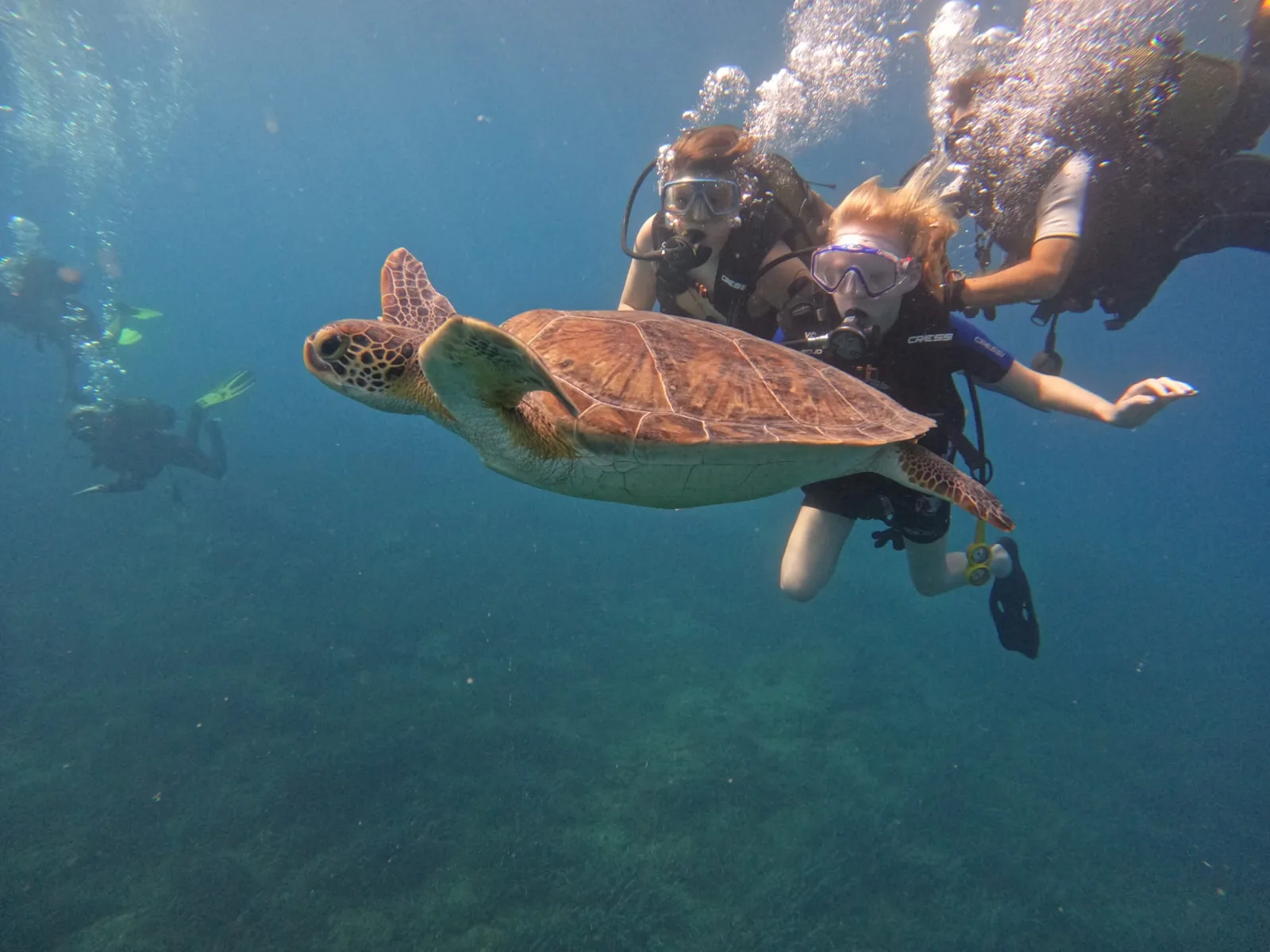
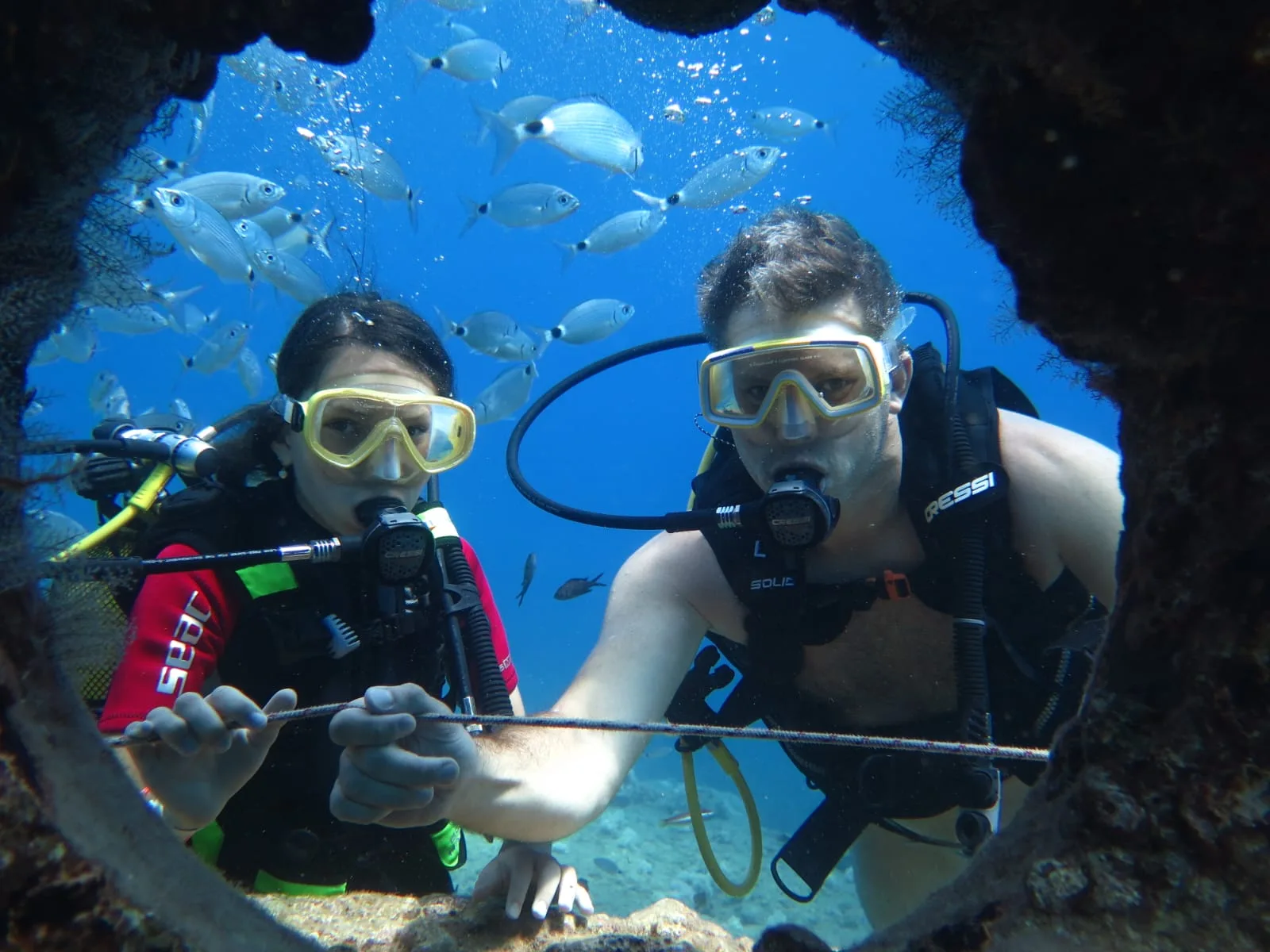
The deeper you go and the longer you stay, the more nitrogen your tissues quietly stockpile. Even on our gentle beginner profile — a morning dive at five to eight metres and an afternoon dive at about thirteen metres — your body surfaces with more dissolved nitrogen than it started with. Certified divers on the deeper profiles — around thirty metres on standard certified dives, and down to sixty metres on the deep sites — load up considerably more, so the same rule matters even more to them. That is completely normal and completely safe, as long as the nitrogen leaves your body slowly.
Off-Gassing: The Slow Goodbye
After a dive, the excess nitrogen doesn't vanish; it leaves gradually through your lungs over hours as your tissues return to equilibrium. Divers call this off-gassing. It is why ascending slowly matters during the dive, and why what you do after the dive matters too.
If pressure around you drops too fast while your tissues are still loaded, the dissolved nitrogen can come out of solution as bubbles — like opening a shaken soda bottle. In the body, those bubbles cause decompression sickness (DCS, "the bends"): joint pain in mild cases, serious neurological problems in severe ones. Recreational diving profiles like ours are designed with wide safety margins precisely so this never gets close to happening — provided you respect the time rules.
Why the Aeroplane Is the Problem
Here is the key fact many travellers don't know: passenger aircraft cabins are not pressurised to sea level. Cruising cabins are typically kept at a pressure equivalent to roughly 1,800–2,400 metres of altitude. For an ordinary tourist that is harmless. For a diver whose tissues are still carrying extra nitrogen, boarding a flight is a second ascent — a rapid drop in ambient pressure on top of the one you already made coming up from the dive.
That is the entire logic of the rule. The waiting time lets your body finish off-gassing at sea-level pressure, so the cabin altitude has nothing left to bubble. Mainstream guidelines recommend a minimum of 12 hours after a single no-decompression dive and at least 18 hours after multiple dives or multiple days of diving. Since our trips always include two dives, and since safety margins are free while helicopter rides are not, we apply a straightforward 24-hour rule for all our guests. One number, no mental arithmetic after a long happy day at sea. More on our approach on the diving safety page.
How to Plan Your Holiday Around It
The rule sounds restrictive but is easy to design around:
- Dive early in the holiday. The best slot for your diving day is the first half of your stay — you keep full flexibility and can even come back for a second trip.
- Keep the last full day dry-ish. If your flight leaves Saturday evening, Friday morning diving is fine — but the cleanest plan is to make Thursday your last dive day.
- The last day is for the surface. Snorkelling is not diving — no compressed air, no nitrogen loading — so joining a boat as a visitor on your final day is perfectly fine, as is swimming and sunbathing.
- Mind the mountains too. Driving to high altitude soon after diving raises the same concern as flying. The Taurus mountain excursions behind Antalya are best kept for a non-diving day.
A typical week in Side solves itself: arrival day to settle in, diving day two or three — the Underwater Museum trip is the classic — a second diving day mid-week if the sea has seduced you (browse the other routes, from Kumköy to Alanya, or see the whole picture in our Antalya diving guide), and the last day for the beach, the old town and the packing you postponed. Once the flight time is fixed you can plan backwards from it, so lock in your departure transfer before you fly and the airport run stops competing with your last day at sea.
Three Small Habits That Help Your Body Off-Gas
- Drink water. Good hydration supports circulation, which is what carries nitrogen to your lungs.
- Skip the post-dive sprint. Heavy exercise right after diving is best avoided; the sunbed on deck is doctor's orders for once.
- Go easy on alcohol after the dives. It dehydrates — celebrate, but with a glass of water alongside.
The Short Version
Diving loads your body with nitrogen; time at surface pressure unloads it; an aircraft cabin interrupts that unloading. Wait 24 hours and the problem simply does not exist. Every booking with us includes passenger and diving insurance, a full safety briefing, and instructors who will happily answer the nerdiest pressure question you can invent — we love those.
Planning your dive days is easier with prices in front of you: all five boat trips are on the prices page, bookable free online with payment on the day and free cancellation up to 24 hours before. Book the dive for the start of the holiday — and fly home with nothing in your blood but good memories.